
Lighting Solutions Tailored to Your Educational Goals and Budget
- Educational lighting needs vary dramatically: From simple classroom demonstrations to advanced research facilities requiring different equipment and approaches.
- Budget and goals determine the best fit: Commercial-focused programs need different solutions than research-oriented or attention-grabbing experimental setups, while others need the least problematic compromises to fit a minimal budget.
- Scale matters significantly: Small test spaces have different requirements than larger production-oriented greenhouses.
- Multiple pathways to success: Whether prioritizing affordability, versatility, or advanced features, effective solutions exist at every budget level.
- Hands-on learning drives outcomes: The right lighting setup creates engaging educational experiences that prepare students for real-world growing operations, or may prioritize capturing the attention and imagination of new students.
- TotalGrow offers educational and volume discounts: In addition to helping plan your lighting project, we can make your budget stretch farther; reach out to get a custom quote.
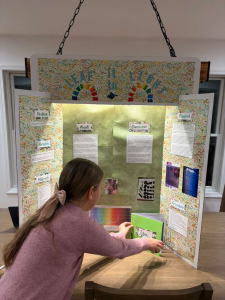
Educational agricultural programs face a unique challenge when selecting grow lights: How do you balance educational value, budget constraints, and preparation for real-world growing scenarios? After working with dozens of schools, FFA chapters, technical colleges, and universities, and even our own kids’ science fair projects, we’ve identified the key factors that determine which lighting solution delivers the best outcomes for each program’s specific situation.
Understanding Your Program’s Lighting Priorities
Before exploring specific equipment options, successful educational lighting plans start by clarifying three fundamental questions:
What’s your primary educational objective?
Commercial-production oriented programs aim to provide experience that equips students for common real-world scenarios they’ll encounter in professional growing operations. These setups prioritize efficiency, cost-effectiveness, and the types of decisions growers make daily about balancing investment versus results.
Research-oriented programs focus on experimental capabilities, allowing students to test variables, compare treatments, and develop critical thinking about how different factors affect plant growth. These setups often include spectrum manipulation, intensity comparisons, and side-by-side trials.
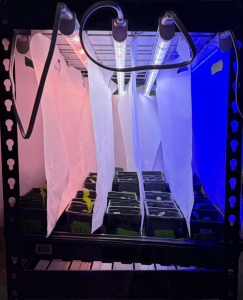
Engagement-focused programs prioritize attention-grabbing features that draw student interest and create memorable learning experiences. Visually distinctive spectrum experiments and dramatic growth comparisons can recruit more students into agricultural programs.
What’s your growing environment?
Greenhouse programs supplement natural sunlight, which significantly impacts equipment selection. The sun’s contribution means spectrum variations have less dramatic effects, and lighting primarily fills gaps during darker months or cloudy periods.
Indoor classroom programs provide 100% of the light plants receive, making nuances of the light plan more influential. Without sunlight to dilute impacts, spectrum choices become more visually obvious and educationally interesting, though light quantity (total intensity/energy of light provided) matters most for actual plant success.
What’s your realistic budget range?
Small budgets (e.g. $15 per indoor square foot or $3 per greenhouse square foot) need the most cost-effective solution that still delivers quality results and meaningful learning experiences.
Medium budgets (e.g. $30 per indoor square foot or $5 per greenhouse square foot) open opportunities for more versatile setups with more dimming capabilities, multiple treatment areas, or higher intensities for diverse crop types.
Generous budgets (e.g. $50-100 per indoor square foot or $10-20 per greenhouse square foot) enable advanced features like multi-channel spectrum control, comprehensive coverage of larger spaces, or research-grade experimental capabilities.
 |
 |
 |
The Critical Hierarchy: Quantity Before Quality
Here’s the most important lighting principle for educational (or any horticultural) programs: light quantity matters far more than light quality (spectrum) for plant success.
Insufficient light intensity causes poor growth regardless of spectrum perfection. Students growing plants under inadequate light learn the wrong lessons—they might conclude that hydroponics don’t work, that LED lighting is inferior, a particular spectrum causes low quality, or that certain crops are difficult, when the real problem was simply not enough photons reaching the plants.
Conversely, adequate or generous light intensity compensates for many other shortcomings. Plants receiving sufficient light can thrive even with less-than-optimal spectrum, demonstrating resilience and providing successful growing experiences that build student confidence and interest. Keep in mind though that excellent intensities may diminish the impacts of other variables when more moderate intensities may cause more interesting differentiation in crop responses.
This creates a strategic framework for educational programs: ensure adequate intensity first, then add spectrum experimentation capabilities if budget and goals warrant.
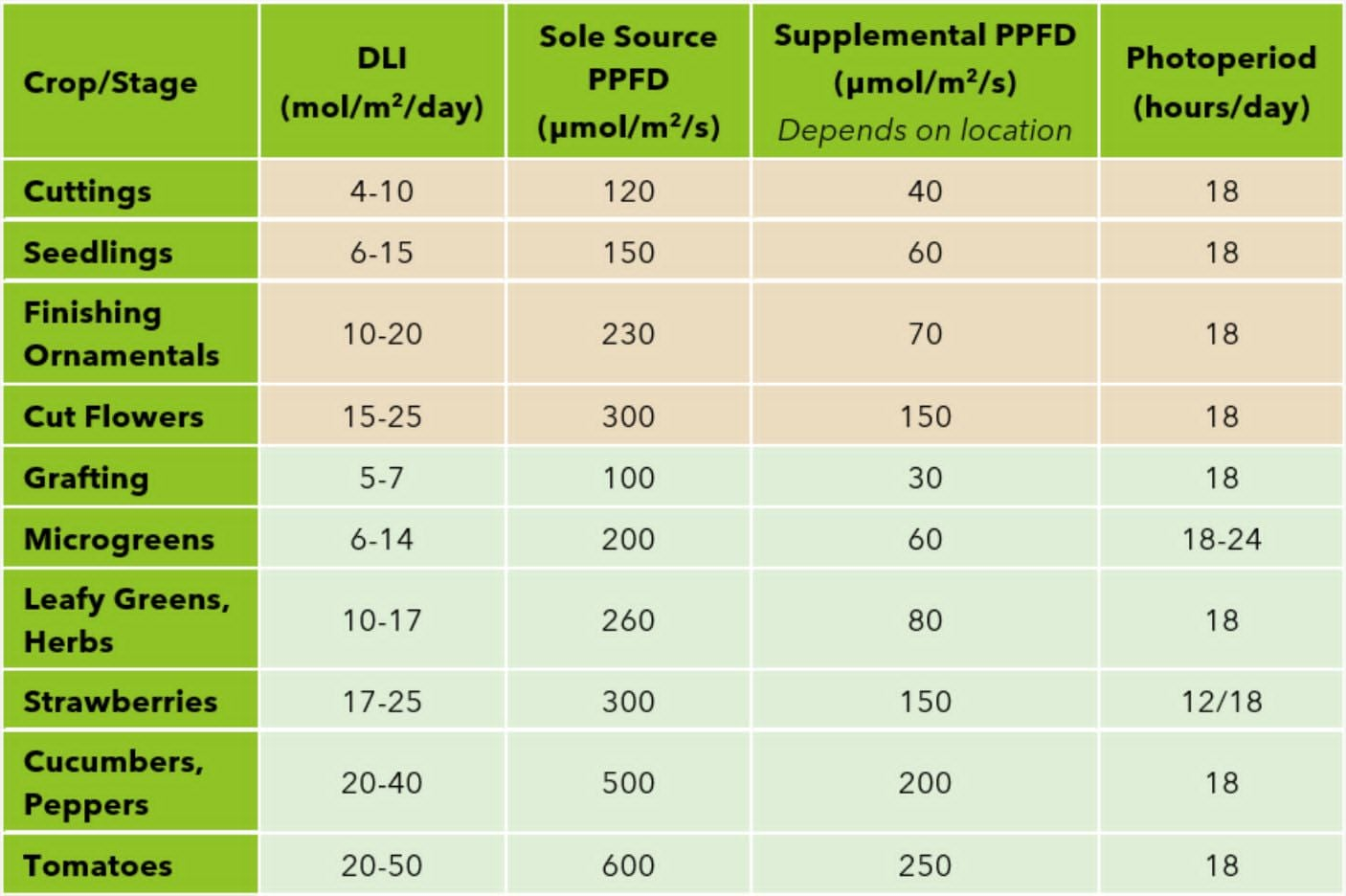
For reference, here are approximate light requirements:
- Microgreens, general early growth: ~150 µmol/m²/s
- Lettuce, herb, all-purpose growth: ~250 µmol/m²/s
- Fruiting, vining, higher-light plants: ~300-600 µmol/m²/s
Understanding Spectrum’s Educational Value
While light quantity drives plant success, light spectrum offers tremendous educational value through visible, memorable comparisons:
Blue light (400-500nm) drives compact, dense growth with darker green/red coloration, enhanced flavors, and higher nutritional content. Students see shorter, stockier plants with thicker stems, tighter internode spacing, and smaller leaves. Edible leaves will have a stronger taste. However, overall biomass accumulation slows compared to balanced spectrum.
Red light (600-700nm) efficiently drives photosynthesis, particularly in smaller plants and lower-light situations. It’s the backbone of cost-effective grow lights because red LEDs offer excellent efficiency, though do add to product costs vs. white LEDs.
Far-red light (700-750nm)—which we barely perceive—triggers expansion responses. Students observe taller plants with larger, thinner leaves and faster overall growth, but less dense, “leggy” structure. This demonstrates shade-avoidance responses that plants use in nature. Edible leaves will have a weaker taste (which may be preferable to those who don’t like vegetables).
Green light (500-600nm) penetrates deeper into plant canopies than other wavelengths and makes plants look natural to human eyes. Plants can use green light for photosynthesis well despite outdated claims that only red and blue photons drive photosynthesis efficiently. It has a weak stretching/expansion impact. We typically provide these wavelengths with white LEDs rather than pure green because white diodes (which also have some blue and red output) are much more cost-effective and reliable.
UVA light (320-400nm) acts as a controlled stressor, potentially enhancing coloration, flavor intensity, and nutrient density through increased secondary metabolite production. However, excessive UVA can slow growth without meaningful quality benefits. Blue and UVA often have similar impacts, but UVA is more expensive with a shorter lifespan and more risk to students’ eyes if looked at directly, so it is less frequently used.
Spectrum experiments create “aha moments” for students. The visual differences between treatments are dramatic and memorable, making abstract concepts about light quality concrete and engaging. The basic principle is that leaves absorb blues and reds most efficiently, so especially blue light cues a plant to invest in strong growth to maintain its position. The light that makes it to shaded leaves has a higher green and far-red percentage, and plants respond to these colors by stretching to try to catch more light or reach more direct sunlight.
Practical Lighting Solutions by Program Type
Option 1: Simple Classroom Production Setup ($150-$500)
Best for: Small-scale classroom growing, limited budgets, commercial-production mindset.
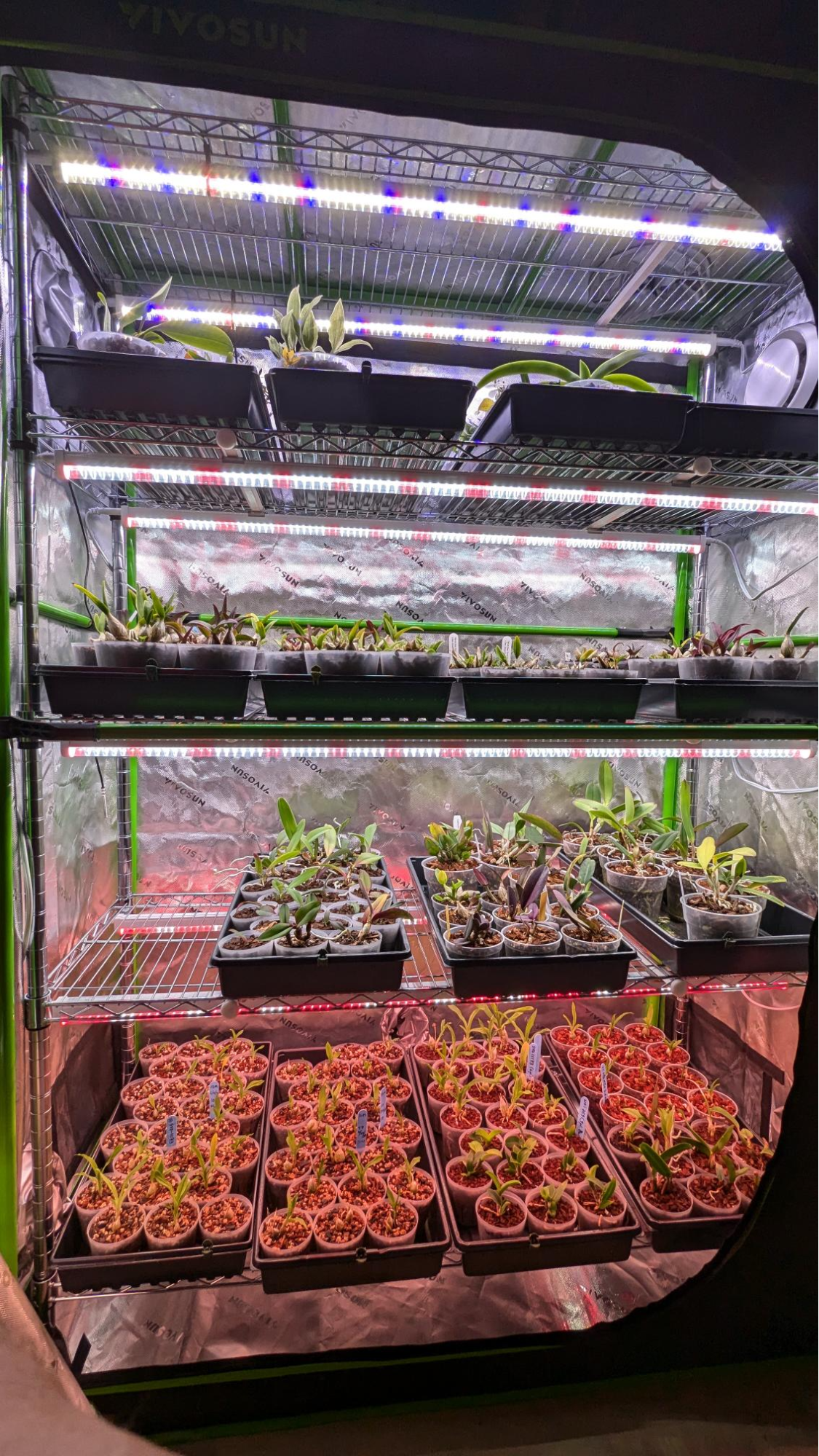
E.g. 18”x48” grow shelves or 4’x6’ hydroponic setup with few or no variables being tested to gain experience with basic growing.
TotalGrow Stratum 20W bar 3-pack per 18”x48” shelf ($135/shelf), or 1 Mezzo 100W bars per 2’x4’ of indoor area or 4’x6’ of greenhouse area ($175 each) provide balanced spectrum at appropriate intensity for greens, herbs, and general propagation.
The Stratums and Mezzos represent the “commercial mindset” approach: minimize costs while producing quality crops, but are lower-powered lights to appropriately illuminate smaller areas. Students learn to think about return on investment, operational efficiency, and the economic realities growers face daily.
Limitations to note: Fixed spectrum without dimming means you can’t easily accommodate both low-light and high-light crops simultaneously. Add/remove or turn on/off lights to adjust intensities received by plants. The above intensities are appropriate for leafy greens and herbs but somewhat weak for fruiting crops like tomatoes.
Option 2: Intensity Comparison Setup ($400-$700+)
Best for: Teaching the critical importance of light quantity, demonstrating growth rate impacts.
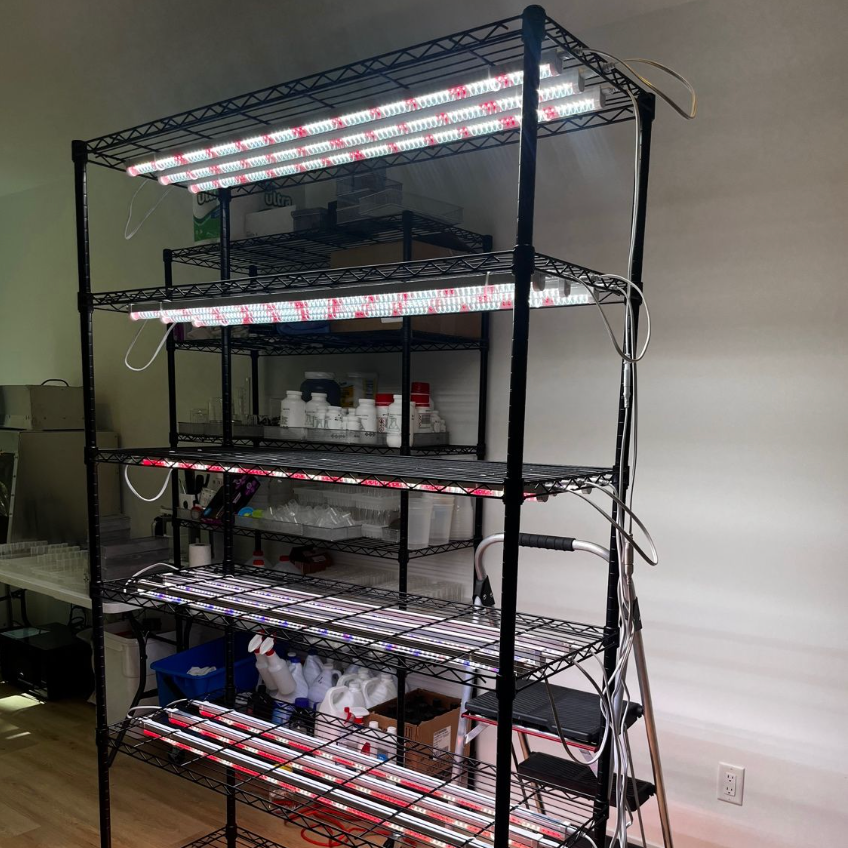
For ~18”x48” racks, compare different quantities of 20W Stratums on different shelves, for example:
- Shelf 1: 2 lights: ~125 µmol/m²/s for lower intensity
- Shelf 2: 3 lights: ~190 µmol/m²/s for moderate intensity
- Shelf 3: 4 lights: ~250 µmol/m²/s for a good, “commercial” intensity
- Shelf 4: 5 lights: >300 µmol/m²/s for high-end intensity
Alternatively, over a setup like an indoor 4’x6’ hydroponic system, vary the concentration of Mezzo lights to create a gradient of intensities, e.g.:
- Light #1 centered over the first 3 ft (18” from the edge): ~150 µmol/m²/s average intensity
- Light #2 centered over the next 2 ft (48” from the edge): ~225 µmol/m²/s average intensity
- Light #3 centered over the final 1 ft (66” from the edge): ~450 µmol/m²/s average intensity
Students observe dramatically different growth rates and plant quality across the zones when growing identical crops. This creates the foundational understanding that the density of lights, thus the light quantity, is the primary limiting factor in plant production.
A gradient of intensities being tested at once is preferable to repeating an experiment with dimmable lights at different settings to provide clearly observable and measurable impacts all at once.
The lesson extends beyond growing: students learn about investment decisions (more lights cost more but produce faster, higher-quality crops), space efficiency trade-offs, and the economic calculations commercial growers make when planning facilities.
Why this matters: Students/growers may assume spectrum is the “secret” to successful growth because it’s visually interesting. Demonstrating that light quantity drives results teaches critical thinking about separating marketing claims from agronomic reality.
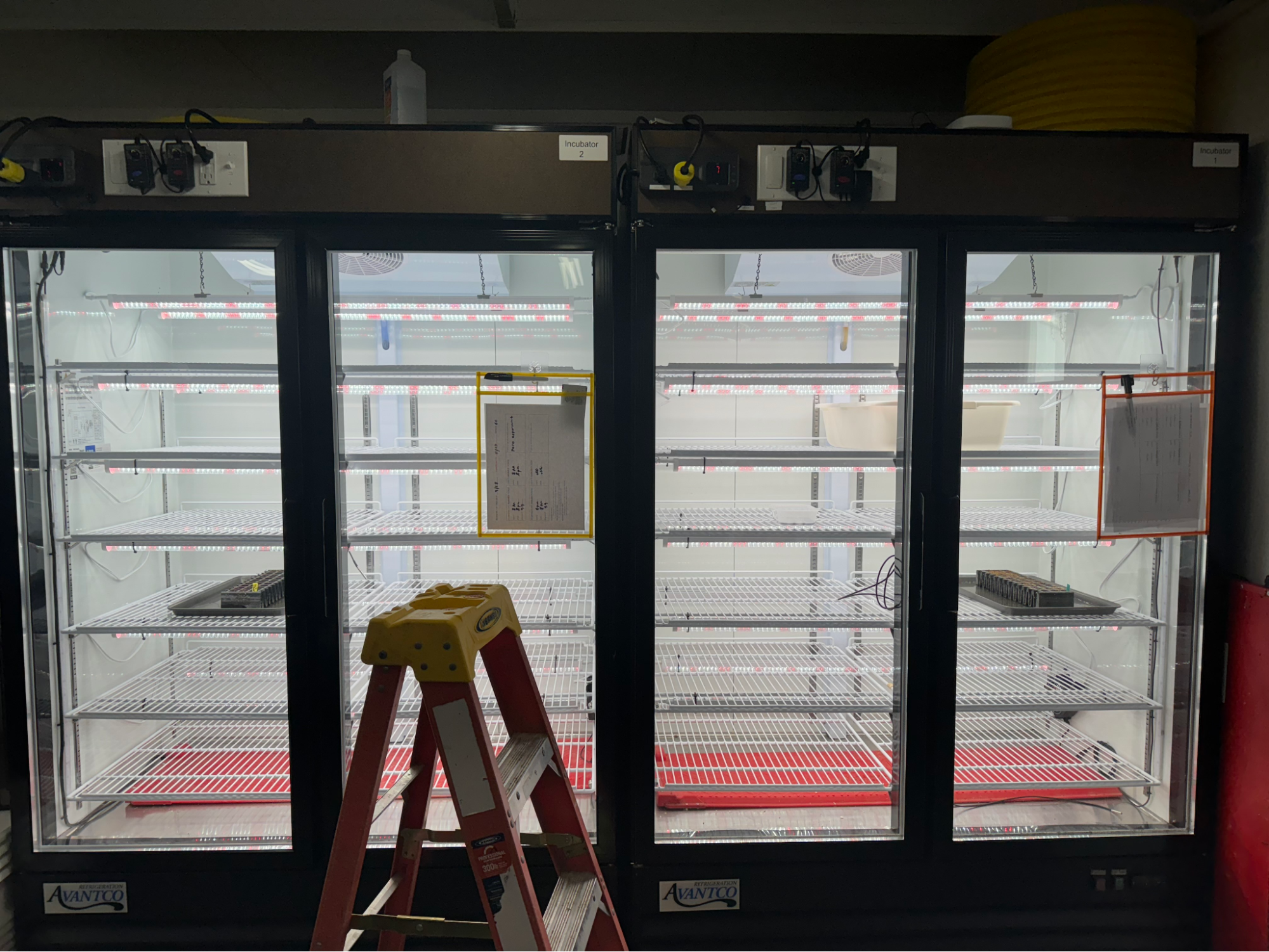
Option 3: Spectrum Experimentation – Multi-Treatment ($600+)
Best for: Engaging student interest, demonstrating photomorphological responses, research mindset.
In a racked setup, utilize different spectra of Stratum 20W bars for different shelves at moderate intensities, e.g.:
- High-Blue bars (3 lights) for more compact, dense vibrant growth
- Balanced spectrum (3 lights) for typical growth morphology
- High-Red bars (3 lights) for a slightly less dense growth
- High-Red + Far-Red bars (3 lights) for more expansive growth
This configuration creates side-by-side comparisons running simultaneously with identical crops under different spectral treatments. Students observe real-time differences in plant morphology, growth rates, and quality characteristics.
The visual impact is powerful, plants under high-blue light look noticeably different from those under high-far-red, creating memorable learning experiences and great talking points for recruiting more students into agricultural programs.
Educational bonus: This setup introduces experimental design concepts—controlling variables, replication, treatment comparison, and data collection—that prepare students for research-oriented careers or advanced studies.
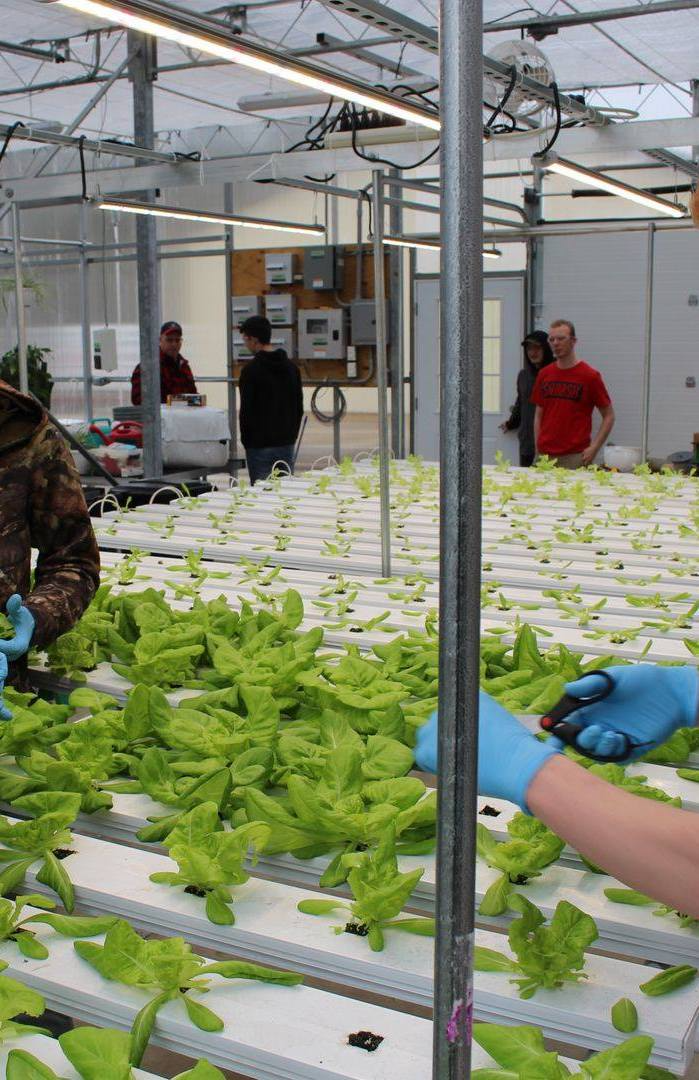
Option 4: High-Intensity Production Space ($419-$1,399+)
Best for: Growing larger fruiting crops, providing commercial-level intensity experience, maximum versatility.
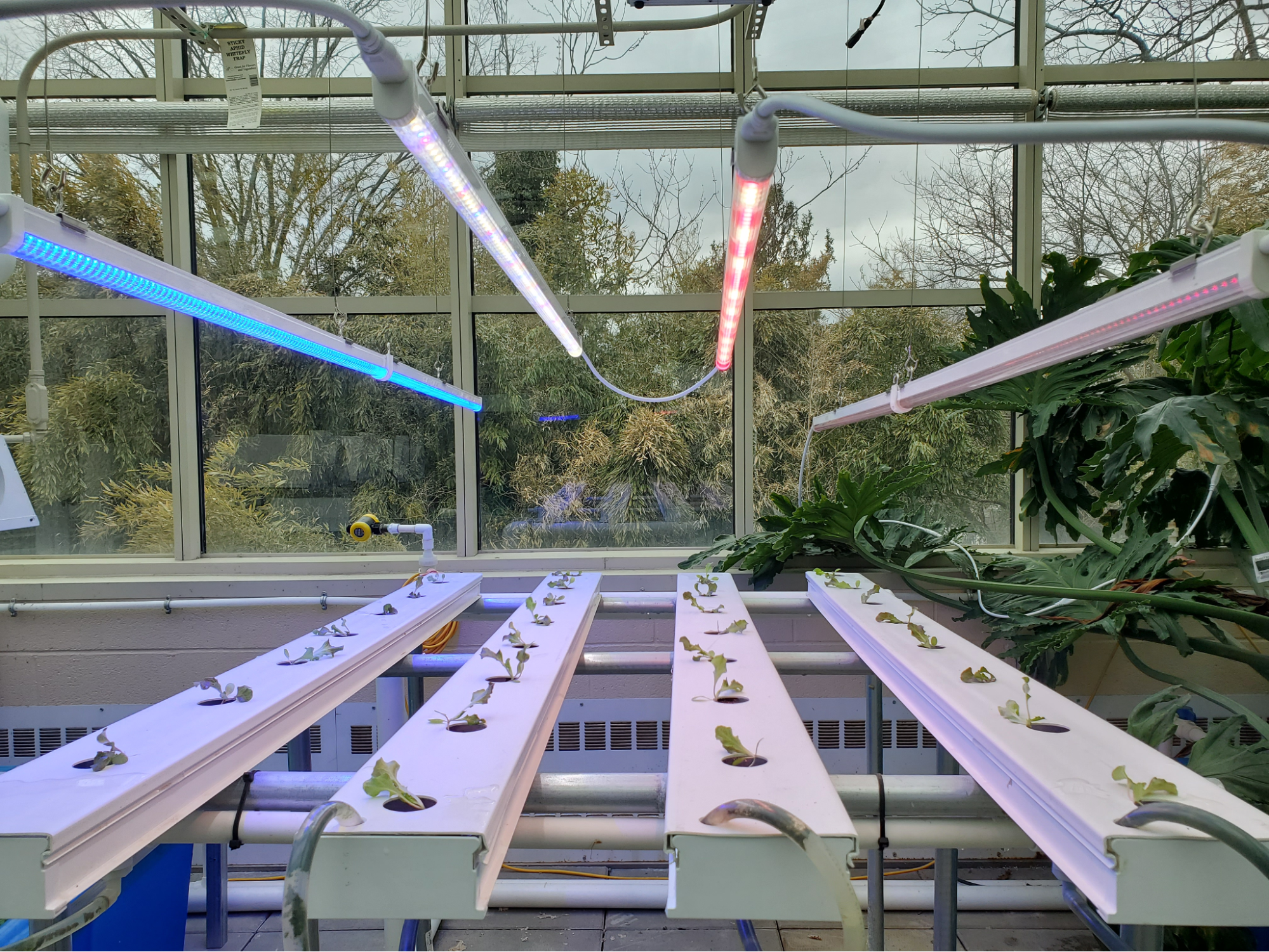
For more elaborate testing of intensities and spectra, it is useful to use 4’x4’ modules of space indoors. Readily available grow tents are a great tool for isolating setups from one another and making a small, controllable environment. Greenhouse equivalents are also very possible but require more situational planning and guidance.
To test variable, high intensities with a fixed spectrum that can support high quality growth of literally any crop, the TotalGrow Lumit 720W ($419) is extremely cost effective to light a 4×4 – 5×5 space. At up to 1,200+ µmol/m²/s with easy dimming to light more gently. This is a highly-relevant setup for preparing future professional growers.
To invest in spectral tuning, the Solark 250W ($739) for moderate or low-light plants like lettuce or Solark 1000W ($1399) for high-light plants like tomatoes provides premium levels of adjustability of all things lighting-related. This is useful for professional preparation, but also an intriguing tool for educators in a position to show off their capabilities and attract new students, donors, volunteers, etc. with the novelty of such lighting setups.
Option 5: Larger Greenhouse Programs
Best for: Schools with dedicated greenhouse facilities, commercial production-scale training, comprehensive coverage.
Greenhouse lighting planning requires additional information:
- Total greenhouse dimensions and bench layout (fixed benches vs. flexible space)
- Mounting height available from benches to overhead structure
- Which areas need general-purpose lighting vs. specialized experimental zones
- Existing environmental control systems and automation capabilities vs. new control needs
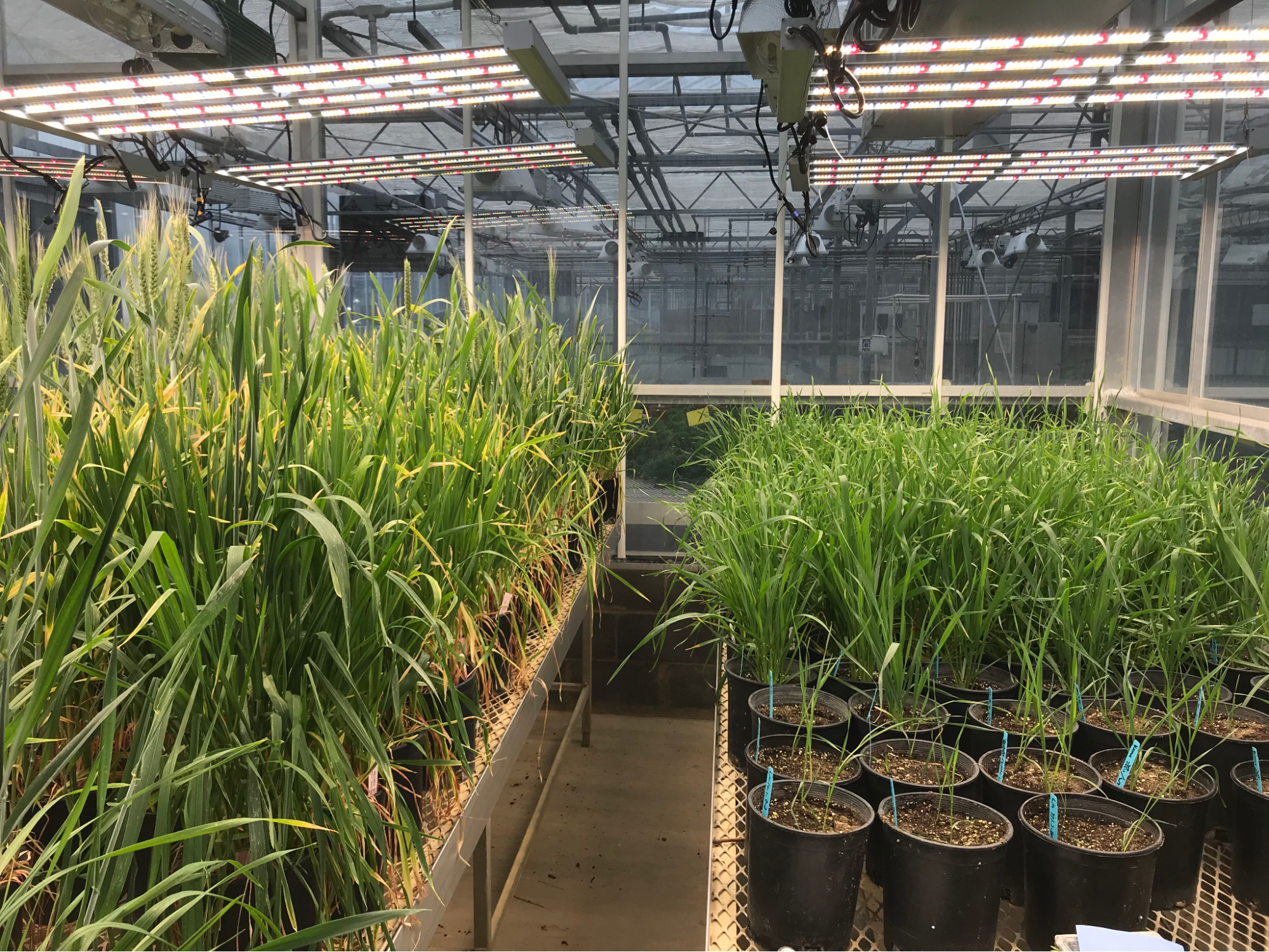
TotalGrow HI-Top lights are purpose-built for greenhouse environments:
HI-Top 660W ($689 each before discounts): Single 4-foot bar covers approximately 140-200 square feet with supplemental lighting intensity (e.g. 12-16’ typical spacing, ~6-10’ above crops). The narrow profile minimizes shading of natural sunlight. Optional side reflectors improve edge uniformity.
HI-Top 345W ($439): Single 2-foot bar covers approximately 100-150 square feet (e.g. 10-12’ spacing, ~5-10’ above crops). Ideal for somewhat smaller benches or areas requiring less intense supplementation.
Specialized spectrum HI-Tops available in pure blue ($579) and pure far-red ($709) at 345W for photomorphological experimentation over larger areas where height permits proper coverage.
Real-world example: A blueberry breeding program installed a combination of standard 660W lights for general supplementation plus smaller quantities of blue and far-red 345W lights, allowing researchers to experiment with different spectral manipulations to accelerate desired breeding responses across different bench sections.
For smaller greenhouse benches or more focused coverage, TotalGrow Mezzo 100W bars ($175) each cover approximately 30-48 square feet, providing more granular control over which specific areas receive supplemental lighting.
Environmental control considerations:
- Simple approach: Timers controlling light on/off schedules
- Moderate sophistication: Timers + dimming control for groups of lights
- Automated approach: Light sensors that turn lights on/off or dim/brighten based on natural light levels versus target thresholds
- Comprehensive system: Full environmental controller managing lights alongside temperature, humidity, CO2, and other variables
Making the Decision: A Framework
To identify your program’s best fit, consider this decision framework:
If your primary goal is cost-effective crop production preparing students for commercial growing careers:
- Small space: Mezzo 100W bars
- Larger space or greenhouse: HI-Top 345W or 660W based on area
If your primary goal is teaching fundamental lighting principles:
- Create intensity comparison treatments with multiple Stratum 20W bars at different densities
- Emphasize that quantity matters more than quality (spectrum)
If your primary goal is student engagement and recruitment:
- Use spectrum experimentation with multiple Stratum 20W bars in different spectra
- Or use Solark 250W / 1000W with 3-channel / 4-channel control for dramatic color-change capabilities
If you need to accommodate diverse crop types including fruiting plants:
- Lumit 720W provides maximum intensity with dimming flexibility
- Or step up to Solark if spectrum control is also desired
If you have generous budget and want maximum educational versatility:
- Combine approaches: use high-intensity primary lighting (Lumit 720W or Solark) plus supplemental experimental spectrum bars (Stratum 20W in various spectra) that can be added to different areas to create treatment comparisons
Installation and Integration Tips
Mounting heights matter: Position lights at 50-100% of the spacing distance between fixtures, with 60-75% often being ideal. For example, lights on 12-foot centers should hang at a minimum of 6 feet above crops, with around 8 feet being optimal. Closer mounting works for small quantities of lights, higher mounting suits larger installations.
Electrical planning: All TotalGrow lights accept 100-277V input. Daisy-chaining capabilities reduce installation complexity. For example, Stratum 20W bars can link up to 20 units on 110V, 40 units on 220V, or 50 units on 277V, meaning you can often run an entire classroom setup from a single power drop.
Start as conservative as needed; add capacity later: The first step is the most beneficial, and additional intensity/functionality can be added later.
Document and compare: Educational value multiplies when students track growth rates, measure plant characteristics, photograph development, and analyze differences between treatments. Build documentation into your curriculum, this transforms a growing space into a research facility.
Educational Discount and Budget Planning
All TotalGrow lights qualify for educational discounts:
- Minimum 10% discount for educational institutions
- Greater volume pricing discounts are also available
- Supply partners can add valuable complementary equipment
- Multi-year equipment planning support available
Contact TotalGrow’s education specialists to discuss your program’s specific needs, budget constraints, and growth plans. We’ve helped design lighting systems for everything from small FFA chapter projects to comprehensive university research facilities.
Moving Forward: Start With Clear Goals
The most successful educational lighting installations begin with honest assessment of priorities. A $400 setup focused on the right educational objectives delivers better outcomes than a $2,000 installation pursuing unclear or contradictory goals.
Consider these questions:
- What specific skills should students gain from this growing space?
- What crops will you grow, and in which seasons?
- How many students will use the space simultaneously?
- What’s your realistic budget for initial investment?
- Do you have support for ongoing electricity costs?
- Will this be a multi-year program with potential for expansion?
With clear answers, TotalGrow’s lighting experts can design a customized solution that delivers maximum educational value within your constraints. We don’t just sell lights—we partner with educational programs to ensure every dollar of your budget works as hard as possible. Our team has designed systems for FFA chapters, technical schools, community colleges, and major universities, and we understand the unique challenges educational institutions face: tight budgets, diverse student skill levels, varying program goals, and the need to demonstrate results to administrators and funders.
We’ll work directly with you to create a lighting plan that fits your space, serves your curriculum, and grows with your program. We even offer educational and bulk order discounts to stretch your budget further. Contact us to discuss your specific situation, we’re here to help you build something that truly works for your students.
FAQ: Educational Grow Lighting
Should we prioritize spectrum control or light intensity in our classroom setup?
What’s the minimum viable lighting setup for a small classroom growing space?
How do greenhouse programs differ from indoor classroom programs in lighting needs?
Can we start small and expand later, or should we invest in the “final” setup immediately?
How do we decide between multiple small lights versus one large powerful light?
Multiple smaller lights (like Stratum 20W bars) provide better uniformity, allow creation of different treatment zones, and offer flexibility to adjust which areas receive lighting. One large light (like Lumit 720W) costs less per watt of capacity, reduces electrical installation complexity, and provides higher maximum intensity for demanding crops. Choose based on your primary goal: if teaching experimental comparison matters most, use multiple smaller lights; if growing diverse crops efficiently matters most, use one powerful light with dimming.


